
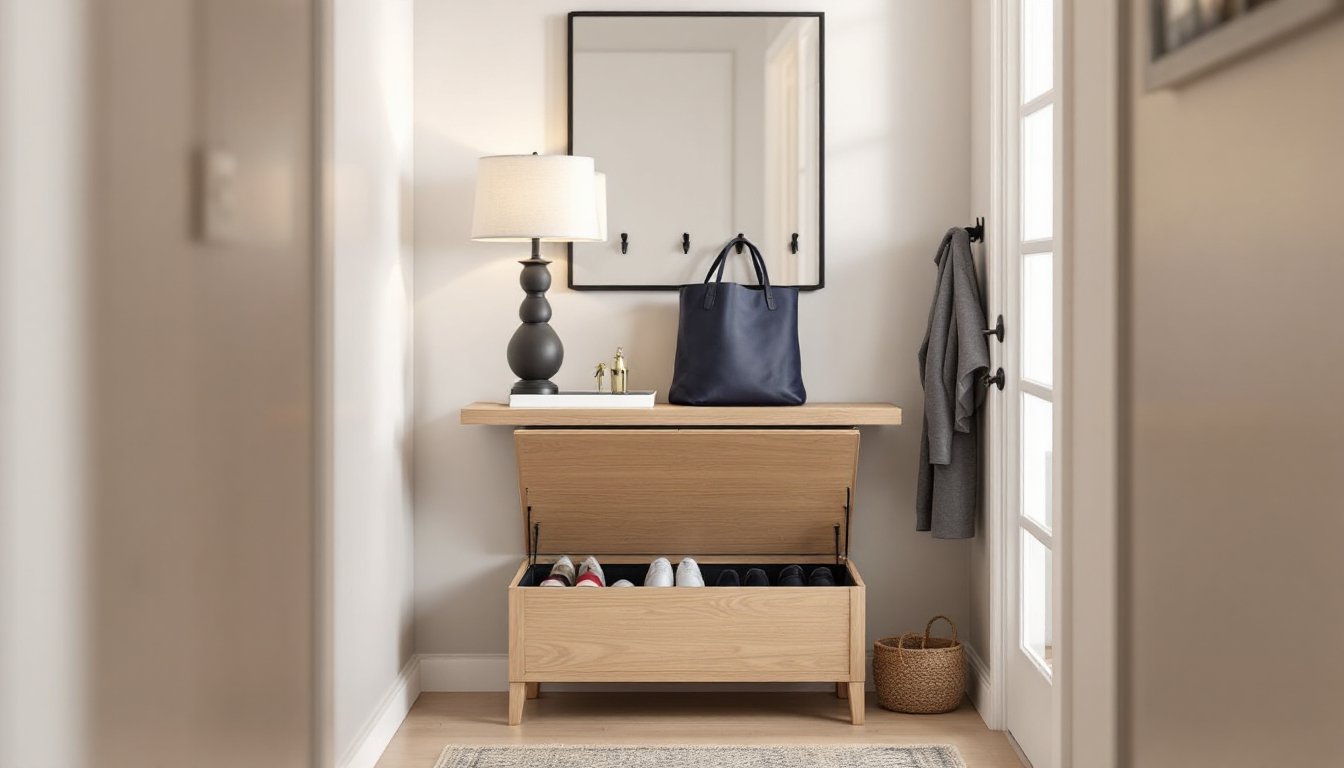
A cramped entryway can undermine the entire feel of a home, guests trip over shoes, keys vanish into the void, and coats end up piled on the nearest chair. But square footage isn’t the issue: it’s how the space is equipped. Even a 3-foot-wide hallway can function efficiently with the right furniture scaled to its dimensions. The difference between chaos and order often comes down to choosing pieces that serve double duty, mount vertically, or tuck into corners without blocking traffic flow. This guide breaks down the specific furniture types, dimensions, and design tricks that make small entryways work harder.
Table of Contents
ToggleKey Takeaways
- Entryway furniture for small spaces must prioritize function over aesthetics, with pieces scaled to dimensions (consoles no deeper than 10-12 inches, benches 16-18 inches deep) to avoid blocking traffic flow.
- Multi-functional storage pieces like lift-top benches and wall-mounted solutions maximize both seating and storage within a compact 24-inch-deep footprint.
- Vertical storage, corner furniture placement, and elevated pieces with visible legs create visual spaciousness and maximize usable square footage in narrow hallways.
- Strategic mirror placement, light paint colors, and consistent furniture finishes amplify perceived space and reduce visual clutter in small entryways.
- Measure door swing arcs and maintain at least a 30-inch clear pathway before selecting furniture to ensure both entering and exiting remain functional for multiple people.
Why Your Small Entryway Deserves Strategic Furniture Choices
Most homeowners treat the entryway as leftover space, whatever doesn’t fit elsewhere gets shoved near the front door. That approach fails in compact layouts where every piece competes for floor area and sightlines.
A poorly planned entryway creates bottlenecks. A console table that’s too deep (more than 12 inches) blocks foot traffic in a 36-inch hallway. A storage bench without clearance for the door swing becomes a useless obstacle. And furniture that doesn’t account for vertical space wastes the most valuable real estate in tight quarters.
Strategic furniture choices solve three core problems: storage (keys, mail, shoes, bags), transition (a spot to drop items when entering), and visual anchoring (defining the zone so it doesn’t feel like a neglected corridor). When a small entryway has these elements dialed in, the rest of the home feels more organized by extension.
Ignore the Pinterest advice about “making a statement.” In a small entryway, function dictates form. A mirror that reflects natural light does more for perceived spaciousness than any decorative flourish. A wall-mounted coat rack frees up floor space that a freestanding hall tree would consume. The goal isn’t to eliminate furniture, it’s to choose pieces that earn their footprint.
Essential Furniture Pieces That Work in Compact Entryways
Not every entryway needs the same setup, but certain furniture types deliver consistent results in tight spaces. The key is matching the piece to the available wall length and depth.
Slim Console Tables and Wall-Mounted Options
A console table provides a landing zone for keys, mail, and daily essentials without dominating the floor plan. In small entryways, depth matters more than width. Look for tables no deeper than 10-12 inches, anything beyond that intrudes into walkways and forces awkward sideways shuffling.
Wall-mounted consoles take this further by eliminating legs entirely. A floating shelf with a 1.5-inch thickness and a depth of 8-10 inches offers enough surface for a catchall tray and a table lamp without any floor footprint. Mount it at 32-34 inches from the floor (standard console height) to maintain visual consistency with freestanding furniture.
For renters or anyone avoiding wall anchors, leaning consoles work as a middle ground. These thin tables brace against the wall at a slight angle, supported by a rear leg or brace. They’re not load-bearing, don’t stack heavy items, but they handle everyday entryway tasks.
Material choice affects both durability and visual weight. A steel-frame console with a glass top feels lighter than a solid wood piece of the same dimensions. In narrow entryways where furniture sits in sightlines from other rooms, lighter materials reduce visual clutter.
Avoid consoles with lower shelves unless they’re open wire or slat designs. A solid lower shelf traps dust, looks heavy, and limits where shoes or baskets can sit underneath. Open frames keep things flexible.
Multi-Functional Storage Benches
A storage bench solves two problems: seating for pulling on shoes and enclosed storage for items that clutter the floor. In small spaces, this is one of the highest-return furniture investments.
Dimensions dictate usability. A bench should be 16-18 inches deep (enough to sit comfortably without tipping backward) and 18 inches tall (standard seating height). Width depends on the wall, but even a 36-inch bench provides meaningful seating and storage.
Lift-top benches hide shoes, dog leashes, reusable shopping bags, and seasonal accessories. Look for gas-lift hinges instead of plain piano hinges, they hold the lid open while you dig through contents, which matters when you’re balancing on one foot. Some models include a safety hinge that prevents the lid from slamming shut, a smart feature if kids use the space.
For entryways with zero floor space, a wall-mounted fold-down bench flips up when not in use. These require solid anchoring into wall studs with lag bolts, drywall anchors won’t support body weight safely. Expect to locate studs at 16-inch on-center spacing (standard residential framing) and plan the bench width accordingly.
Storage cubbies built into the bench’s frame offer a compromise between open and closed storage. Shoes stay accessible but contained, and baskets can slide into cubbies for a cleaner look. Cubbies sized at 12 inches wide by 12 inches tall fit most adult shoes and small bins.
Pair a storage bench with wall-mounted hooks above it to create a full drop zone. A coat on a hook, shoes in the bench, keys in a tray on the wall-mounted shelf, that’s the trifecta of entryway organization, all within a 24-inch-deep footprint.
Space-Saving Design Strategies for Maximum Impact
Choosing the right furniture is half the equation. The other half is positioning it to maximize usable space and flow.
Vertical storage beats horizontal every time. A tall, narrow cabinet (think 12 inches deep by 24 inches wide by 72 inches tall) holds more than a wide console table while occupying the same floor area. Use the top two-thirds for closed storage (coats, bags, cleaning supplies) and the bottom for shoes or boots. This keeps the visual center of gravity high, which tricks the eye into perceiving more space.
Corner furniture unlocks dead zones. Most entryways have at least one corner that goes unused. A corner shelf unit or a triangular console table fits into that 90-degree angle without blocking pathways. Corner benches work the same way, especially in L-shaped entryways where two walls meet near the door.
Reflective surfaces amplify light and depth. A mirror opposite a window or light source bounces illumination into dark corners and creates the illusion of a larger room. Mount a 24-by-36-inch mirror above a console table or go full-length (18 by 64 inches) if wall space allows. Mirrored furniture, like a console with a mirrored apron, adds reflectivity without requiring a separate mirror, though the effect is subtler.
Furniture with legs creates sightlines. Solid pieces that sit flush to the floor feel heavier than furniture elevated on legs. A console table with 4-inch legs or a bench with visible supports allows the eye to see the floor beneath, making the room feel less crowded. This matters more in very small entryways where every visual trick counts.
Multipurpose pieces reduce clutter. A coat rack with an integrated umbrella stand eliminates the need for a separate holder. A mirror with built-in hooks serves double duty. Every piece that combines functions is one fewer item competing for space.
Measure door swing arcs before placing anything. A standard interior door swings 90 degrees and requires a clearance radius equal to the door width (typically 32-36 inches). Furniture placed inside that arc creates a collision course. Use painter’s tape on the floor to map the swing before committing to a layout.
Consider traffic flow in both directions. The entryway isn’t just for entering, people exit through it carrying bags, strollers, and groceries. Leave at least a 30-inch pathway clear from the door to the next room. Tight squeezes work when you’re alone but fail when two people meet at the threshold.
Styling Tips to Make Your Small Entryway Feel Larger
Function comes first, but styling choices can enhance or undermine a small entryway’s usability.
Light colors recede: dark colors advance. Painting the entryway wall in a shade two steps lighter than adjacent rooms makes the space feel more open. White, soft gray, and pale beige work universally. If the rest of the home uses bold color, reserve it for accents (a painted door, a single decorative piece, or hardware) rather than walls.
Consistent furniture finishes create cohesion. Mixing wood tones, metal finishes, and paint colors in a small space looks chaotic. Stick to one or two finishes across all entryway furniture. A black metal console, black hooks, and black-framed mirror read as intentional. A wood bench, brass hooks, and chrome mirror read as random.
Limit accessories to functional items. A bowl for keys, a tray for sunglasses, a basket for dog leashes, these earn their place. Decorative objects that serve no purpose just create visual noise. Small spaces benefit from strategic organization that keeps surfaces clear.
Lighting sets the tone. If the entryway lacks overhead lighting, add a plug-in wall sconce or a battery-operated LED puck light mounted inside a cabinet. Task lighting makes finding items easier and reduces the cave-like feel of a narrow hallway. Aim for 40-60 watts (or LED equivalent) to adequately light a small entryway without harsh glare.
Scale artwork and decor to the wall size. A single large piece (think 24 by 36 inches) anchors better than a gallery wall of small frames. Gallery walls work in spacious entryways but feel cluttered in tight ones. If wall space is limited, skip art entirely and let the mirror or furniture be the focal point.
Use baskets and bins for hidden storage. Open shelves and cubbies look neat when filled with uniform containers. Woven baskets, fabric bins, or wire mesh boxes corral small items while maintaining a clean appearance. Choose bins that fit cubbies exactly, gaps waste space and look sloppy.
Many small space living strategies emphasize decluttering as a styling tool, and it applies here. A small entryway with three well-chosen pieces feels intentional. The same space with six pieces feels cramped, even if the total furniture footprint is identical. Edit ruthlessly.
For tight budgets, creative IKEA modifications can transform basic pieces into custom solutions. A KALLAX shelf unit mounted horizontally becomes a floating console. A HEMNES shoe cabinet cut down to fit a narrow wall provides hidden storage without a custom price tag. Just be sure modifications don’t compromise structural integrity or void any return policies.
Conclusion
Small entryways don’t need to be afterthoughts. With furniture scaled to the space, vertical storage to maximize walls, and a focus on multi-function pieces, even a 3-foot-wide hallway becomes a functional drop zone. Skip the decorative filler, measure twice, and choose pieces that solve real problems. That’s how a cramped entry turns into a space that actually works.